AI Writing Assistant: Why Most Tools Solve the Wrong Problem
Most AI writing assistants fix grammar on text you've already written. The real bottleneck is everything before that: research, angle, structure. Here's what actually moves the needle.
The average blog post takes 3 hours and 25 minutes to write, according to Orbit Media's 2025 survey of 808 content marketers. That number has actually dropped in recent years, likely because of AI tools. And yet, only 21% of those same marketers report "strong results" from their content.
The math doesn't add up. If writing is faster than ever, why aren't results improving? Because speed at the wrong stage doesn't fix the bottleneck.
Here's what this piece covers: why most AI writing assistants focus on the easy part, where the real time actually goes, and what a different kind of assistance looks like when the goal is content that ranks and gets cited.
Table of Contents
What most AI writing assistants actually do
An AI writing assistant is a tool that helps you produce written content using artificial intelligence, as opposed to a tool that writes everything for you from scratch. The category includes grammar checkers like Grammarly, paraphrasers like Quillbot, and the writing features built into Microsoft Word and Google Docs. For a broader look at where these tools sit next to full content generators, see this roundup of AI tools for content writers.
The common thread is that they work on text you've already written. You draft something, then the assistant polishes it: fixing typos, suggesting clearer phrasing, adjusting tone. Grammarly alone reports over 40 million daily active users as of 2025, and the company's own case studies claim users save an average of 20 days per year on editing tasks.
40 million+
Daily active users of Grammarly worldwide in 2025. Grammarly, self-reported, 2025
That's a real benefit. Editing is tedious, and catching errors you've read past three times is genuinely hard. The limitation is where these tools sit in the workflow: after you've already done the thinking, the research, the structuring, and the drafting. They make the last mile faster, but the last mile was never the slowest part.
Consider what Grammarly does when you paste in a paragraph. It checks spelling, flags passive voice, suggests synonyms, and scores readability. What it does not do is ask whether you're covering the right topic, whether your angle differentiates from the ten other articles ranking for the same keyword, or whether your structure matches what the search intent actually requires. Those decisions were made upstream, and they determine whether the article performs more than any amount of polish ever could.
Where the time actually goes when creating content
Orbit Media's annual blogger survey breaks down what content marketers spend their hours on. The 2025 data (808 respondents) shows the average article takes 3 hours and 25 minutes. That's a number that's been falling, likely because more people are using AI somewhere in the process. But here's the part that doesn't show up in that average: the correlation between AI usage and results.
Only 10% of marketers use AI to write complete articles, and that group is the least likely to report strong results. The marketers who see the best outcomes use AI for editing and idea generation, not for drafting entire pieces. In other words, they're using AI as an assistant, not a replacement, but they're using it at the wrong stage to move the needle on performance.
What Orbit Media's 2025 Survey reveals about content creation
- 3h 25m Average time to write a blog post in 2025 Orbit Media, 2025
- 10% Of marketers use AI to write complete articles (the least successful group) Orbit Media, 2025
- 21% Of content marketers report "strong results" from their content Orbit Media, 2025
- 1,333 Average word count per article (down from previous years) Orbit Media, 2025
The survey also shows what separates the 21% who report strong results from everyone else. They publish longer, more visual content with original research, in collaboration with influencers, and they align content with keywords. None of those things are about fixing grammar. They're about decisions made before a single word is drafted.
The hidden time sink
The 3.5-hour average only counts the time people consciously attribute to "writing a blog post." It doesn't fully account for the research loop that precedes it: figuring out what angle isn't already saturated, pulling data from credible sources, structuring the piece to match search intent, optimizing for the terms people actually use. Those tasks often happen in fragments across days, get interrupted, and don't feel like "writing time" even though they determine whether the writing matters.
This is where the mismatch becomes clear. A grammar assistant that saves 20 days a year on editing is valuable if editing is the bottleneck. For most content marketers, it isn't. The bottleneck is everything that comes before.
What kind of assistance actually moves the needle
The correlation data from Orbit Media points to a pattern: the content that performs is the content where someone made good decisions before drafting. Good topic selection, an angle that isn't already saturated, research that produces original data or expert quotes, structure that matches what the searcher actually wants.
Mark Schaefer, quoted in the same survey, put it directly: "Too many content marketers are focusing on using AI to cut some corners instead of doubling down on quality."
"This is the first year we've seen the impact of AI in a significant way but there hasn't been an improvement in results. Too many content marketers are focusing on using AI to cut some corners instead of doubling down on quality."
Mark Schaefer, Speaker and Marketing Strategist, in Orbit Media's 2025 Blogging Survey
Quality, in this context, isn't about prose. It's about substance: original research, specific data, structure that serves the search intent, optimization that gets the piece found. The grammar is table stakes, not the game.
Three capabilities that change the equation
If you think of content creation as a pipeline, the stages that determine success happen early:
- Topic research and angle selection. Picking a keyword is the beginning, not the end. The top five results for any competitive term share most of their coverage. An article that covers the same ground ranks sixth at best. The question is what the existing results don't cover, and that requires reading them, not just checking search volume.
- Structure and intent matching. A "how to" query wants steps. A "best X for Y" query wants a comparison. A definitional query wants a clear answer in the first paragraph. Getting this wrong means the content doesn't satisfy the search intent, which is the single strongest signal Google uses for ranking.
- Optimization for both SEO and AI citation. Traditional SEO (keywords in the right places, internal links, metadata) still matters. But now AI search engines (ChatGPT, Perplexity, Google's AI Overviews) are pulling answers directly from content. Getting cited requires specific formatting: data with sources and years, definitions at the start of sections, self-contained sentences that can be extracted without context.
A grammar assistant doesn't touch any of these. A different kind of assistant could.
How Mark works as an AI writing assistant
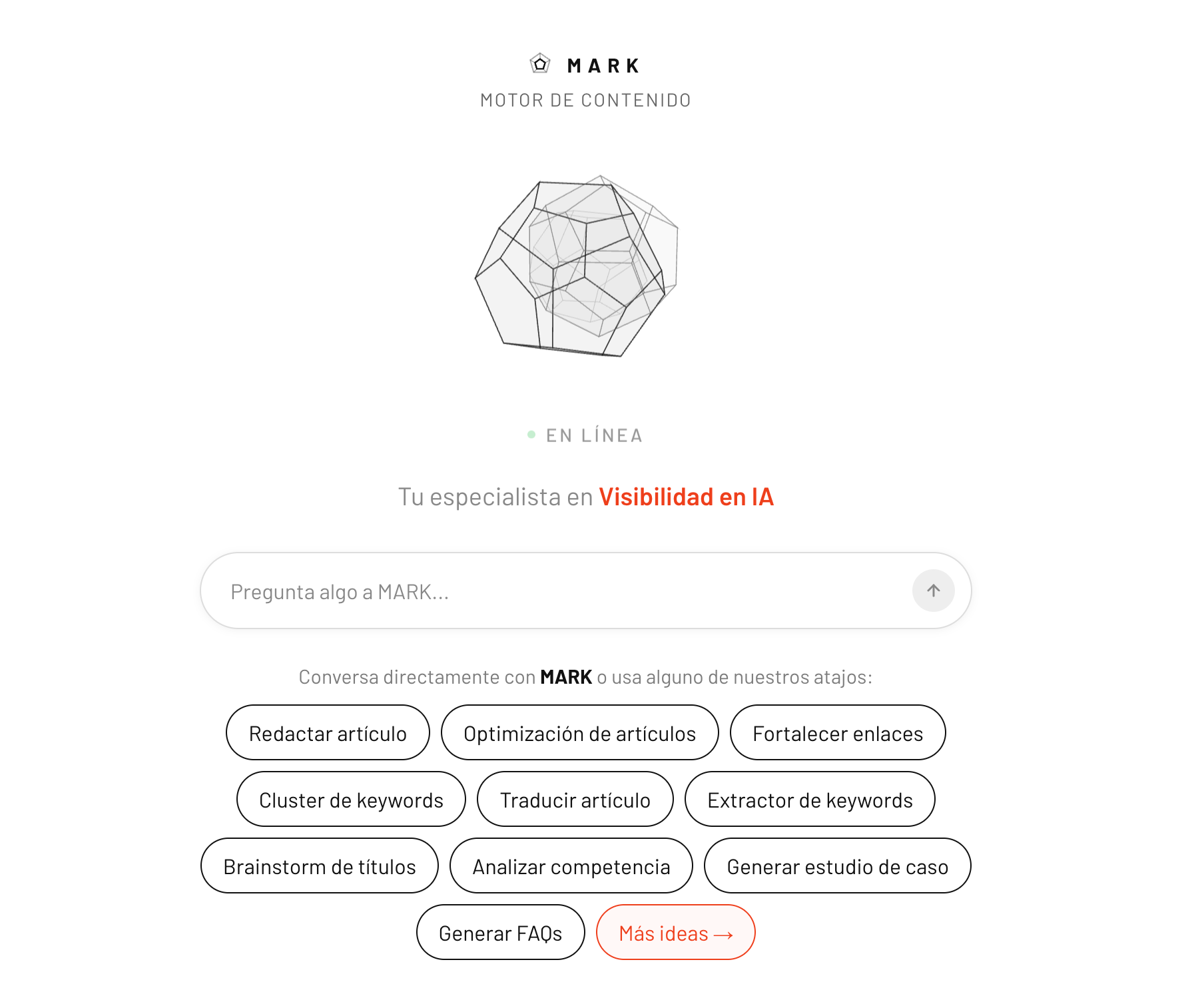
Mark is an AI writing assistant built for the stages that determine whether content performs. It's not a grammar checker, not a paraphrasing tool, and not a standalone content generator you paste prompts into. Mark connects directly to your CMS (WordPress, Webflow, HubSpot, or Wix) and handles the research, structuring, writing, and publishing as a single workflow.
The research phase
When you ask Mark to write an article, it starts by analyzing what already ranks. This means reading the actual top results for your keyword, identifying what every competitor covers (the table stakes), and finding what none of them cover (the opportunity). The angle comes from that gap, not from a generic understanding of the topic.
Mark also checks your existing content to avoid cannibalization. If you already have an article targeting a similar keyword, Mark will tell you before you duplicate effort or create competing pages.
The writing phase
The article itself follows a structure matched to the search intent, includes data from credible sources (with citations and years inline), and builds in the formatting that makes content extractable for AI search engines: definitions at section starts, self-contained summary sentences, data blocks that can be cited without surrounding context.
Internal links get added contextually. A table of contents gets built from the headings. FAQ sections get structured data markup so they're eligible for rich results.
The publishing phase
Mark publishes directly to your CMS as a draft. The featured image, meta title, meta description, slug, and focus keyword are all set in the same action. You review and publish when ready. After publishing, Mark identifies older posts that should link back to the new article and can insert those links automatically.
What this changes in practice
The difference is where the work happens. With a grammar assistant, you do the research, find the angle, write the draft, structure it for SEO, then run it through the tool to catch typos. With Mark, you specify the topic and the article comes back ready to review, with the research already reflected in the content, the structure already matched to the intent, and the optimization already built in.
This isn't about removing the human from the process. It's about removing the human from the parts of the process that don't require human judgment: reading ten articles to find the gap, checking for cannibalization, formatting tables of contents, inserting schema markup. The judgment calls (is this angle right for my audience? does this match my brand voice?) stay with you.
When you don't need this kind of assistant
Mark is built for a specific problem: producing content that ranks and gets cited, consistently, without requiring expertise in SEO or hours of research per piece. If that's not your problem, a different tool fits better.
If your bottleneck is typos and clarity in short-form writing (emails, Slack messages, social posts), Grammarly or a similar grammar assistant is the right fit. These tools excel at polishing text you've already written, and they work across every application on your computer.
If you need a general-purpose AI chat interface for brainstorming, coding, analysis, or one-off questions, ChatGPT or Claude gives you that flexibility. They're not specialized for content marketing workflows, but they're not trying to be.
If you're writing long-form content that doesn't need to rank (internal documentation, personal essays, fiction), the SEO and GEO optimization that Mark provides isn't relevant. A simpler writing tool lets you focus on craft without the structure overhead.
If you already have a content team with dedicated SEO expertise, the research and optimization Mark automates might be work your team already does well. The value proposition shifts: Mark might still save time, but the gap is smaller than for someone without that expertise.
The honest version of the tradeoff is this: Mark is more specialized than general writing assistants, which means it does one job better and doesn't try to do everything else. If your job is blog content that needs to perform in search (including AI search), that specialization is the point. If your job is something else, it's overhead.
The next step if content is your bottleneck
Content marketing works. Orbit Media's data shows 81% of marketers report at least some results from it (60% "some results," 21% "strong results"). But the marketers seeing strong results are doing things most people skip: original research, influencer collaboration, keyword alignment, long-form depth. Those aren't shortcuts. They're work.
Mark exists to make that work manageable without adding headcount. If you're publishing content that should rank but doesn't, or spending hours on research that gets spread across a busy week, or putting off your blog because the effort-to-output ratio never feels right, this is what Mark was built for.
The first article is free. No credit card, no commitment. You'll see exactly how the research, writing, and publishing works, with a real piece on your real topic, before you decide whether it fits.
Frequently Asked Questions
What's the difference between an AI writing assistant and an AI content generator?
An AI writing assistant helps you at specific stages of the writing process, while an AI content generator produces entire pieces from a prompt with minimal input. Most grammar tools like Grammarly are assistants that work on text you've already written. Mark is an assistant that works on the research and optimization stages, then produces the draft, so you're reviewing rather than writing from scratch.
Does using an AI writing assistant hurt my search rankings?
Google's guidance is that AI-generated content is acceptable as long as it's helpful to users. The risk isn't using AI. The risk is producing low-quality content, whether by AI or by human. Orbit Media's 2025 data shows that marketers who use AI for editing and ideation report similar results to those who don't use AI at all. The marketers who see worse results are those who use AI to write complete articles without oversight.
How is Mark different from Grammarly or Quillbot?
Grammarly and Quillbot work on text you've already written, improving grammar, clarity, and tone. Mark works earlier in the process: it analyzes what's ranking for your keyword, finds the angle that isn't saturated, structures the article for search intent, writes it with data and sources, and publishes to your CMS. The tools solve different problems at different stages of content creation.
Do I still need to edit content that Mark produces?
Yes, and that's intentional. Mark produces drafts ready for your review, not published posts without oversight. You should check that the angle fits your brand voice, that the data is relevant to your audience, and that the piece says what you want it to say. The goal is to reduce the time from topic to publishable draft, not to remove your judgment from the process.
Bibliography & references
- reports over 40 million daily active users
- Orbit Media's annual blogger survey
Ready for MARK to write your next articles?
Set it up in minutes. Researched, optimized for SEO and GEO, and published straight to your CMS.